Monday, February 08, 2010
End of this blog (for now?)
Blogger will stop supporting ftp upload soon, so I won't be able to continue this blog unless I put some effort rewriting it. In the future you may be able to find my current blog in the links section of my Google Profile. You can also check out my friendfeed and my Twitter accounts.


Sunday, September 27, 2009
Google Sidewiki
Google Sidewiki, a project I've been working on launched last week. Sidewiki is a web annotation system currently available in Google Toolbar. If you're interested in this project, follow @googlesidewiki on Twitter and submit product ideas!
Tuesday, February 24, 2009
Trouble installing a new hard drive
I was running of of space and I recently decided to upgrade to a bigger hard drive. I have done such upgrades in the past, including one on the same computer and I've never had any problems, so I thought that this one will be equally easy. Little did I know what ordeal I was in for...
I have a Dell E521 with Windows Vista and I wanted to buy a SATA drive for it. I went to Fry's and decided to buy the Seagate 1.5 TB drive since they had a sale and this drive was the same price as 1 TB drives.
I got home, replaced the old drive with the new one, rebooted, installed Seagate software (DiscWizard) and started to format the drive. Almost immediately, I got an error: "Failed to read from the sector -1,644,227,123 on the hard disc 2".
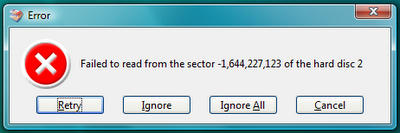
This is not good I thought. But it was very suspicious that the number was negative and that I got the error so quickly, so I decided to use the built-in format feature of Windows. Since I got this error, I decided to go for the full format rather than quick format. As you can expect, it took many hours. After about 4 hours, the format was stuck at 75% and I decided to go to bed. When I got up in the morning, it was still at 75%. At this point, I decided to give the quick format a try and like Seagate's DiscWizard, it reported an error almost immediately. OK, the drive is bad then.
I went to Fry's and exchanged the drive for a new one. I inserted it, tried DiscWizard and got the same error (although for a slightly different negative number). Quick format also got me an error. The fact that the full format failed previously at 75%, made me decide to format the disc for only 1 TB. This took many hours and eventually worked! I now had a 1 TB drive for a price of 1 TB drive (since it was on sale).
Great, I marked the partition as "Active, Primary Partition" and assigned it letter D.
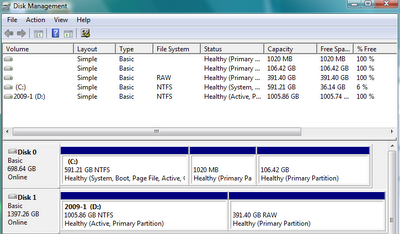
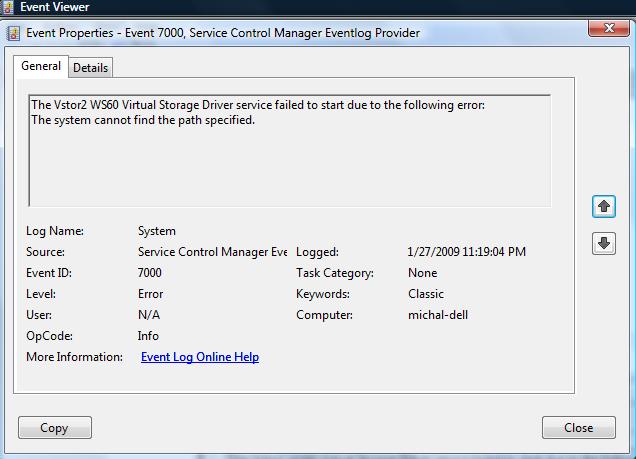
Now I rebooted the computer to make sure that everything worked. No disc D. Well, perhaps I forgot something. I look in the disk management tool and I see that the partition is there. It's still Healthy, still Active and still Primary but the letter assignment is gone. I assign the letter again and reboot. No dice. OK, let me check the system log. Sure enough, the event viewer shows an error: "The Vstor2 WS60 Virtual Storage Driver service failed to start due to the following error: The system cannot find the path specified".
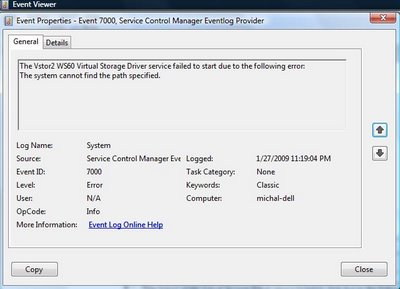
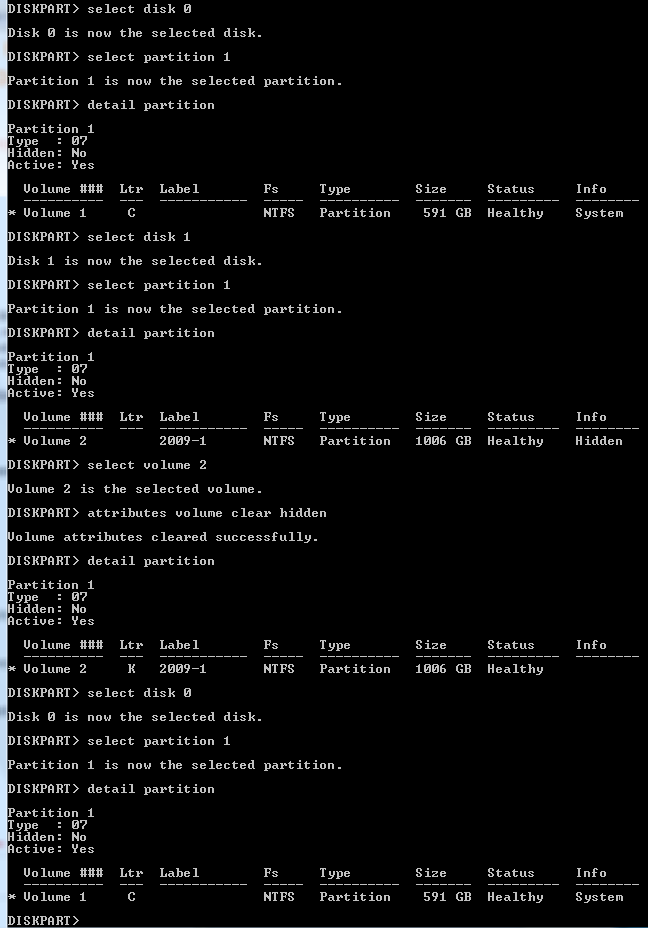
What do I do now? After some time searching on the web, I decided to use diskpart: the low-level, command line Windows utility. It turns out that the partition was marked as "Hidden" and I had to undo this using the arcane syntax of diskpart. See the screenshot below what it looked like:
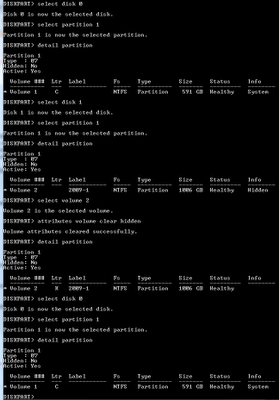
So, I wasted probably 10 hours of my life because of buggy software. And why doesn't the default disk management tool even tell me of the existence of the Hidden attribute. What if this happened to someone who knows even less about computers? After all, I may not be the biggest expert and perhaps there exist people who would immediately know what was wrong and the using diskpart was the fix but I mentioned this to a few friends who like me have been using computers for years and everyone was amazed how bad this experience was. Maybe this blog past will help others who run into this problem. I'm guessing this this problem is confined to Vista but there must be other Vista users who want to install this drive.
And if anyone knows how to use all 1.5 TB on Vista, let me know!
I have a Dell E521 with Windows Vista and I wanted to buy a SATA drive for it. I went to Fry's and decided to buy the Seagate 1.5 TB drive since they had a sale and this drive was the same price as 1 TB drives.
I got home, replaced the old drive with the new one, rebooted, installed Seagate software (DiscWizard) and started to format the drive. Almost immediately, I got an error: "Failed to read from the sector -1,644,227,123 on the hard disc 2".
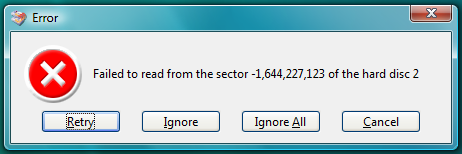
This is not good I thought. But it was very suspicious that the number was negative and that I got the error so quickly, so I decided to use the built-in format feature of Windows. Since I got this error, I decided to go for the full format rather than quick format. As you can expect, it took many hours. After about 4 hours, the format was stuck at 75% and I decided to go to bed. When I got up in the morning, it was still at 75%. At this point, I decided to give the quick format a try and like Seagate's DiscWizard, it reported an error almost immediately. OK, the drive is bad then.
I went to Fry's and exchanged the drive for a new one. I inserted it, tried DiscWizard and got the same error (although for a slightly different negative number). Quick format also got me an error. The fact that the full format failed previously at 75%, made me decide to format the disc for only 1 TB. This took many hours and eventually worked! I now had a 1 TB drive for a price of 1 TB drive (since it was on sale).
Great, I marked the partition as "Active, Primary Partition" and assigned it letter D.
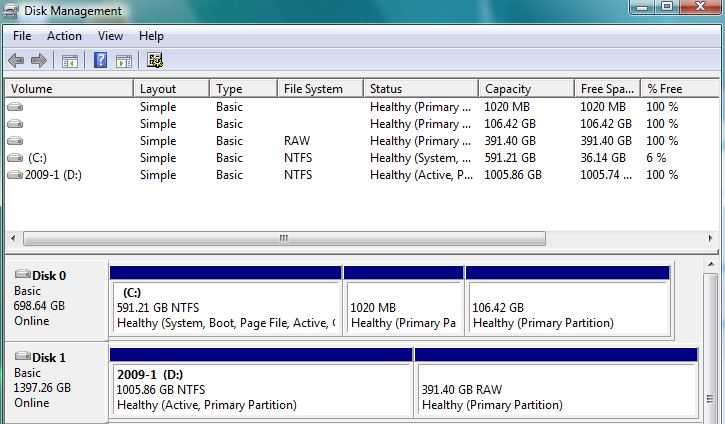
Now I rebooted the computer to make sure that everything worked. No disc D. Well, perhaps I forgot something. I look in the disk management tool and I see that the partition is there. It's still Healthy, still Active and still Primary but the letter assignment is gone. I assign the letter again and reboot. No dice. OK, let me check the system log. Sure enough, the event viewer shows an error: "The Vstor2 WS60 Virtual Storage Driver service failed to start due to the following error: The system cannot find the path specified".
What do I do now? After some time searching on the web, I decided to use diskpart: the low-level, command line Windows utility. It turns out that the partition was marked as "Hidden" and I had to undo this using the arcane syntax of diskpart. See the screenshot below what it looked like:
So, I wasted probably 10 hours of my life because of buggy software. And why doesn't the default disk management tool even tell me of the existence of the Hidden attribute. What if this happened to someone who knows even less about computers? After all, I may not be the biggest expert and perhaps there exist people who would immediately know what was wrong and the using diskpart was the fix but I mentioned this to a few friends who like me have been using computers for years and everyone was amazed how bad this experience was. Maybe this blog past will help others who run into this problem. I'm guessing this this problem is confined to Vista but there must be other Vista users who want to install this drive.
And if anyone knows how to use all 1.5 TB on Vista, let me know!
Labels: computers
Tuesday, December 30, 2008
ABBA madness in Poland
Major Polish cities will have an outdoor New Year party. Two of the biggest parties will feature ABBA -impersonators:
- The party in Warsaw is organized by Polsat (a Polish TV station). The stars there include Abbacapella (apparently a German band).
- The party in Wroclaw is organized by TVP 2 (another TV station). ABBA music will be performed there by a Swedish group Arrival. An it seems that Modern Talking is the biggest star there.
Tuesday, October 07, 2008
Trouble with Comcast
I have had pretty bad experiences with Comcast. I first got their service and very soon I started to be very unhappy with the service. I then tried to cancel the service but I have been unsuccessful in canceling the service. The situation is very bizarre and I got really tired after spending hours with their customer service, so I asked for advice and I ended up doing what my friends suggested: I made my story public by creating a blog that describes in details what happened. Check it out! And if you have any advice, let me know!
Saturday, October 04, 2008
Tell No One
I just watched Tell No One at the Aquarius . I haven't watched such a good film for a while. A few things were not very believable and some viewers may not like that fact that this neither a pure action flick, nor a pure romantic film, nor a pure drama. It has a little of each and I'm not sure how to categorize it.

Labels: films
Saturday, August 23, 2008
Children-related posts
Occasionally I want to share information with my friends on children-related topics. I decided to create a separate blog for this purpose.
Labels: children
Saturday, March 15, 2008
Polish flashcards
I have recently created flash cards for the teaching Polish alphabet. The flash cards are designed for toddlers, so they have simple, colorful pictures and simple words containing each letter. I've created a separate web page for "resources for teaching Polish to kids" but chances are that those flash cards are the only thing I will ever put on the site.
It was surprisingly easy to find images that I could use. I downloaded most of them from the public domain clip art repository (http://www.wpclipart.com). One exception is the picture for "ź" which is from http://commons.wikimedia.org. Letter "ź" is by the way the one that was most difficult to find a good word for. Some Polish words can never be at a start of a word, so I could easily give up for them but in general, I wanted for each letter a word that starts with this letter. For "ź", I considered following words: "źdźbło", "źrebię/źrebak", "źródło" i "źrenica". I liked most "źródło" but couldn't find a good image for it (if you have one you can suggest, please let me know). I didn't want to use "źrebię" because my daughter (she was 2 when I started working on the cards) would easily confuse it with the word "koń" or "kucyk". Similarly I didn't want to have to explain the difference between "źrenica" and "oko". So, I ended up using "źdźbło" but this word has four consonants in a row which doesn't really make it the best choice for one of the first words you learn in Polish.
It was surprisingly easy to find images that I could use. I downloaded most of them from the public domain clip art repository (http://www.wpclipart.com). One exception is the picture for "ź" which is from http://commons.wikimedia.org. Letter "ź" is by the way the one that was most difficult to find a good word for. Some Polish words can never be at a start of a word, so I could easily give up for them but in general, I wanted for each letter a word that starts with this letter. For "ź", I considered following words: "źdźbło", "źrebię/źrebak", "źródło" i "źrenica". I liked most "źródło" but couldn't find a good image for it (if you have one you can suggest, please let me know). I didn't want to use "źrebię" because my daughter (she was 2 when I started working on the cards) would easily confuse it with the word "koń" or "kucyk". Similarly I didn't want to have to explain the difference between "źrenica" and "oko". So, I ended up using "źdźbło" but this word has four consonants in a row which doesn't really make it the best choice for one of the first words you learn in Polish.
Labels: Polish
Tuesday, December 04, 2007
Partial hAtom support in my blog
I don't have right now enough time to go all the way but I have just converted my blog's template to partially support hAtom. I think that hAtom is great and some time ago Kevin Marks and I implemented support for hAtom in Blogger templates. Our work means that all new blogs that are created on Blogger and hosted on Blogspot have hAtom enabled by default. But my blog uses an old template that does not benefit from this new code.
It is hard or perhaps even impossible to support hAtom completely with the old templating system but I did as much as I easily could. Here are template elements I modified in my blog (the template used by me is called "Herbert"). In my quick-and-dirty notation below I use bold font combined with underline to show new things added to the template.
It is hard or perhaps even impossible to support hAtom completely with the old templating system but I did as much as I easily could. Here are template elements I modified in my blog (the template used by me is called "Herbert"). In my quick-and-dirty notation below I use bold font combined with underline to show new things added to the template.
- <Blogger><span class="hentry">
- <span class="entry-content"><$BlogItemBody$></span><br />
- <BlogItemTitle><h2 class="entry-title"><BlogItemURL><a href=">$BlogItemURL$>"></BlogItemURL>
<$BlogItemTitle$><BlogItemURL></a></BlogItemURL></h2></BlogItemTitle> - <a href="<$BlogItemPermalinkURL$>" title="permanent link" rel="bookmark">permalink</a>
- I replaced <$I18NPostedByAuthorNickname$>
with <span class="vcard">Posted by <span class="fn"><$BlogOwnerFullName$></span></span> - </span></Blogger>
Friday, May 18, 2007
Bike ride to work
I already had a similar post but now I want to write about since this has been the first week in two years that I biked every day. Usually there's at least one day a week that I need a car or have to go somewhere else, so I have never achieved this until now. To celebrate, I took a camera with me and took a few pictures. I am also testing the new Picasa Web feature and including a slide show from the ride.
Tuesday, May 01, 2007
JavaOne 2007
I will be again at JavaOne this year. I am co-presenting JSR 277: Java Module System. I should be around at JavaOne all of Thursday because I also plan to attend the JSR-294 session (Java Language Modularity with Superpackages) and on Tuesday night to attend the BOF that will talk about both JSRs (Modularity in the Next-Generation Java Platform, Standard Edition (Java SE): JSR 277 and JSR 294).
If you are interested in chatting about Java modularity and will be at JavaOne, drop me a line.
If you are interested in chatting about Java modularity and will be at JavaOne, drop me a line.
Labels: Java
Saturday, December 09, 2006
Publishing videos using Flash
I wanted to publish some videos on my web site in a way that is embeddable in a web page. An additional constraint was that I didn't want to spend much time to learn how to do it. It turns out that quite quickly I found the right tools using Google search.
The first step is a conversion to the FLV (Flash Video) format. For Windows there is a free encoder called Riva VX. I downloaded it and in a few minutes I converted one of my videos to the FLV format.
Next I found the Flash Video Player that makes it possible to embed a video without Flash authoring tools. The player consists of one .swf file, one Javascript file. Those two files and the video are connected together with a little of HTML. I played with it for a few minutes and in my attempts, all four files (.swf, .js, .flv and .html) had to be in the same directory. Since I wanted to embed the video in a file whose location I didn't know and I couldn't assume that it was in the same directory as the other files, I ended up using an iframe that let me embed the video in places like blog posts. Here's the result of my experiment:
The first step is a conversion to the FLV (Flash Video) format. For Windows there is a free encoder called Riva VX. I downloaded it and in a few minutes I converted one of my videos to the FLV format.
Next I found the Flash Video Player that makes it possible to embed a video without Flash authoring tools. The player consists of one .swf file, one Javascript file. Those two files and the video are connected together with a little of HTML. I played with it for a few minutes and in my attempts, all four files (.swf, .js, .flv and .html) had to be in the same directory. Since I wanted to embed the video in a file whose location I didn't know and I couldn't assume that it was in the same directory as the other files, I ended up using an iframe that let me embed the video in places like blog posts. Here's the result of my experiment:
Labels: web
Tuesday, May 09, 2006
JavaOne 2006
After many years, I will be coming to JavaOne again this year. The main reason is to co-present some early information about the Java Module System (JSR-277) at a BOF on Tuesday night. You can see a bit more details in Stanley Ho's blog.
JSR 294: Improved Modularity Support in the Java Programming Language is closely related and if modularity in Java interests you, you should also consider going to a presentation by Gilad Bracha at JavaOne about that JSR.
JSR 294: Improved Modularity Support in the Java Programming Language is closely related and if modularity in Java interests you, you should also consider going to a presentation by Gilad Bracha at JavaOne about that JSR.
Wednesday, April 05, 2006
CGO 2007
I am in charge of the web site for next year's CGO (International Symposium on Code Generation and Optimization). This year's conference just took place in NYC and next year we are moving back to San Jose.
The submission deadline is Friday Sept. 8, 2006 and here is a list of areas suggested in the call for papers:
The submission deadline is Friday Sept. 8, 2006 and here is a list of areas suggested in the call for papers:
- Compilers, back-end code generators, translators, binary optimization tools and runtime environments; static, dynamic, adaptive, or continuous techniques
- Innovative analysis, transformation, and optimization techniques
- Profiling and feedback-directed methodologies
- Memory management, including data distribution, synchronization and GC
- Thread extraction and thread-level speculation, especially for multi-core systems
- Vertical integration of language features, representations, optimizations, and runtime support for parallelism (including support for transactional semantics, efficient message passing, and dynamic thread creation)
- Phase detection and analysis techniques
- Mechanisms and optimization techniques supporting the efficient implementation of security protection models, reliability and energy efficiency
- Traditional compiler optimizations
- Intermediate representations that enable more powerful or efficient optimization
- Hardware mechanisms and systems that implement or assist in any of the above
- Experiences with real dynamic optimization and compilation systems, particularly with large, complex applications
- Explorations of trade-offs concerning when (static/dynamic) and where (software/hardware) to optimize
- Particularly novel ideas of interest to this community
Tuesday, February 21, 2006
PPPJ '06
PPPJ'06 (the 2006 International Conference on Principles and Practices of Programming in Java) will take place in September in Mannheim, Germany. Abstracts of papers for the conference are due on 8 May 2006. The conference range is quite interesting:
- Optimization
- VM Design
- Java Verification
- Aspect-Orientation
- Java-specific metrics
- Software Engineering with Java
- Program Design and Implementation
- Design Patterns through Java
- Testing of Java Programs
- Performance of Java Programs
- Tools for Java Programming
- Java-based MDD/MDA
- Applications in science, engineering, and business
- Novel Applications of Java
- Domain-specific Frameworks
- Java-based Tools
- Java-based Enterprise Computing
- Mobile Java
- Practice and experience
- Java and Financial Services
- Java and the Manufacturing Industry
- Teaching Java Programming
- Teleteaching Applications
- Teaching Methods
Sunday, November 06, 2005
Onboard gambling may lead to free flights on Ryanair
This is pretty amazing: the European airline Ryanair made claims that it might offer gambling on its flights and that gambling would generate enough revenues to make flights themselves free. It's hard to say if this is just a publicity stunt or the future of cheap flights.
W Szczebrzeszynie chrząszcz brzmi w trzcinie
I have discovered by accident that Wikipedia has an entry about the Polish poem Chrząszcz which contains the most famous Polish tongue-twister. They even have an audio recording. Even more amazingly they have a whole list of tongue twisters in many languages including quite a few in Polish. I keep being amazed by the breadth of Wikipedia.
529
529 is a name of a college-savings plan in the US. I don't really know much about them but I've just happened to read an article about them in the Newsweek.
The whole point of using 529 is the fact that you do not pay taxes on investment gains of the money you put in a 529 funds (some states let you even deduct the contributions). This is a little complicated because while you always are free from the federal tax, you have to use your state's 529 plan to avoid the state income tax. The Newsweek article points out that if your state's 529 plan has high fees, it may be better to forgo the state income tax advantage and get a fund with lower fees. Here's a quote from that article on the fees that are common today:
California's 529 plan is the Golden State ScholarShare College Savings Trust. So do this plan's fees compare with the Newsweek guidelines on fees? The combined two fees should be under 0.8% and for the ScholarShare they are exactly 0.8% which probably means that if you pay the California state income tax and you plan to invest in a 529, you should choose the ScholarShare.
The whole point of using 529 is the fact that you do not pay taxes on investment gains of the money you put in a 529 funds (some states let you even deduct the contributions). This is a little complicated because while you always are free from the federal tax, you have to use your state's 529 plan to avoid the state income tax. The Newsweek article points out that if your state's 529 plan has high fees, it may be better to forgo the state income tax advantage and get a fund with lower fees. Here's a quote from that article on the fees that are common today:
Each state levies a program fee for maintaining the plan. (Under 0.3 percent of
the assets in your account is good. Over 0.5 percent is bad. These fees are
dropping fast.) The mutual-fund companies charge management fees. (Under 0.5
percent is good. Over 0.8 percent is bad.) If you buy from a broker or planner,
you also pay sales commissions (sales costs may be hidden; generally, they're
going up).
California's 529 plan is the Golden State ScholarShare College Savings Trust. So do this plan's fees compare with the Newsweek guidelines on fees? The combined two fees should be under 0.8% and for the ScholarShare they are exactly 0.8% which probably means that if you pay the California state income tax and you plan to invest in a 529, you should choose the ScholarShare.
Saturday, October 15, 2005
A-Code: code generation for Ada
During my last trip to Poland, I have been going through my old papers. One of the things I found was a copy of my MSc thesis from the Silesian University of Technology. Unfortunately, I couldn't find the electronic copy of the dissertation but I scanned parts of it and created a pdf file. The thesis is entirely in Polish but I have just created a short abstract in English. The title can be translated into English as Code Generation in the IIPS/Ada Compiler (original Polish title is: Opracowanie i wykonanie modułu kompilatora języka Ada systemu IIPS/Ada generującego kod wynikowy w postaci P-kodu). Unfortunately, as far as I know the IIPS/Ada system was never finished. I guess there were not enough graduating students who wanted to write parts of an Ada compiler system. For the curious, IIPS stands for Instytut Informatyki Politechniki Śląskiej (which means the Computer Science Institute of the Silesian University of Technology). I haven't really stayed in touch with anyone from my alma mater but I can see that my advisor, dr inż. Przemysław Szmal is still there and apparently he is still teaching compilers.
Here is the text of the English abstract of my thesis I just wrote:
This dissertation describes one module of a larger system that was supposed to be a complete set of development tools for Ada. The code generation module described here took the output of earlier compiler phases in the form of the DIANA intermediate language and generated low-level code for an abstract Ada machine. A major part of the works was the design of a language for a virtual machine for interpreting Ada programs. We took the P-Code designed with a similar purpose for Pascal (it was used in the UCSD p-System) and extended it into a language we called A-code.
The dissertation consists of 7 chapters. Chapter 1 presents motivation and describes the overall IIPS/Ada compiler system. Chapter 2 describes the DIANA intermediate language. The bulk of the text is in Chapter 3 that describes the A-Code language. The Turbo Pascal implementation of the code generator is described in Chapter 4. Chapter 5 is the user manual for the code generator and Chapter 6 describes which features of Ada have been implemented and which have been omitted. Conclusions are presented in Chapter 7. Appendix 1 contains the grammar of DIANA. Appendix 2 describes all new A-Code instructions (i.e. those that are not part of the P-Code language). Appendix 3 defines a compiler runtime library that is given in the form of A-Code procedures that can be called from the generated code. Appendix 4 gives the DIANA encoding of (parts of) the STANDARD package. Appendix 5 shows examples of test runs. The tests consist of small Ada procedures or packages manually translated into DIANA. These DIANA representations of the Ada source code were translated by the code generator and the generated A-Code representation is included in the text.
Here is the text of the English abstract of my thesis I just wrote:
This dissertation describes one module of a larger system that was supposed to be a complete set of development tools for Ada. The code generation module described here took the output of earlier compiler phases in the form of the DIANA intermediate language and generated low-level code for an abstract Ada machine. A major part of the works was the design of a language for a virtual machine for interpreting Ada programs. We took the P-Code designed with a similar purpose for Pascal (it was used in the UCSD p-System) and extended it into a language we called A-code.
The dissertation consists of 7 chapters. Chapter 1 presents motivation and describes the overall IIPS/Ada compiler system. Chapter 2 describes the DIANA intermediate language. The bulk of the text is in Chapter 3 that describes the A-Code language. The Turbo Pascal implementation of the code generator is described in Chapter 4. Chapter 5 is the user manual for the code generator and Chapter 6 describes which features of Ada have been implemented and which have been omitted. Conclusions are presented in Chapter 7. Appendix 1 contains the grammar of DIANA. Appendix 2 describes all new A-Code instructions (i.e. those that are not part of the P-Code language). Appendix 3 defines a compiler runtime library that is given in the form of A-Code procedures that can be called from the generated code. Appendix 4 gives the DIANA encoding of (parts of) the STANDARD package. Appendix 5 shows examples of test runs. The tests consist of small Ada procedures or packages manually translated into DIANA. These DIANA representations of the Ada source code were translated by the code generator and the generated A-Code representation is included in the text.
Tuesday, October 04, 2005
VEE Call For Papers
I forgot to write about this earlier but the Call For Papers for next year's Conference on Virtual Execution Environments has been posted. The submission deadline this year is on 15 December 2005. VEE 2006 will bo co-located with PLDI.

Subscribe to Posts [Atom]